


|
|
|
What is Madrigal? | Doc home | Madrigal home |
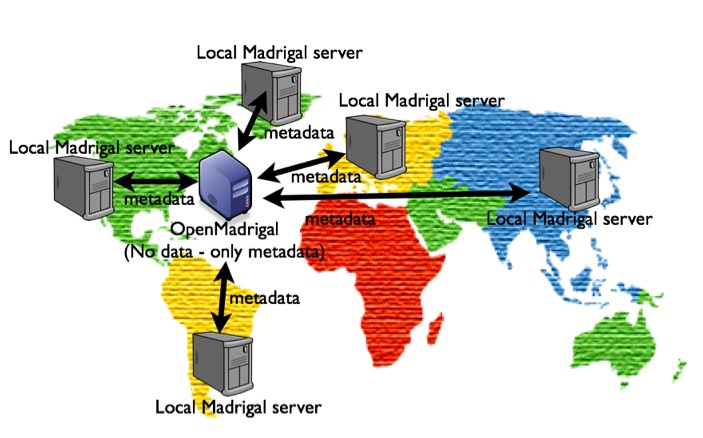
Madrigal is a robust, World Wide Web based system capable of managing and serving archival and real-time data, in a variety of formats, from a wide range of ground-based instruments. Madrigal is installed at a number of sites around the world. Each site controls their own Madrigal installation, and can add or upgrade their data from their instrument(s) on their site at any time. In addition to storing data in the standard Madrigal/Cedar format, each site can also add additional web-based documentation such as plots or descriptive notes to individual experiments they run.
However, Madrigal also defines standard metadata that all Madrigal sites share. This makes it possible for each Madrigal site to know about all the experiments on all the other sites. From a user's point of view, each Madrigal site allows them to search for data at all the Madrigal sites at once, and simply follow links to the Madrigal site that has the data they are interested in.
Madrigal was originally developed to serve the needs of the incoherent scatter radar community. As of Dec 2011, there are Madrigal sites containing incoherent scatter radar data at Millstone Hill, USA, EISCAT, Sweden, Arecibo, Puerto Rico, SRI International, USA, Cornell University, USA, and Jicamarca, Peru. In addition, many of these sites also store data from optical instruments on Madrigal, and the Millstone site holds total electron content data derived from the world-wide network of GPS receivers. Madrigal is designed to hold data from any ground-based instrument that studies atmospheric science.
There is also now a central archive Cedar Madrigal site at cedar.openmadrigal.org. This site archives all the data from the local Madrigal databases, typically on a weekly basis. This site also hosts data sets that are not supported on other Madrigal datbases.
There are two ways to access Madrigal data - through a web browser, or through a programming language for which an application programming interface (API) has been written. This tutorial covers accessing Madrigal data via a web browser. There is also a tutorial covering accessing Madrigal data via API's.
Madrigal is an open source project with a developer's web site. A complete Subversion archive of all Madrigal software, including software which is not included with the standard distribution, is available at the developer's web site. There is also an Open Madrigal mailing list and developer's forum. Any group wishing to install Madrigal to distribute their instrument's data is welcome to - see the www.OpenMadrigal.org web site for details.
|
|
|
What is Madrigal? | Doc home | Madrigal home |